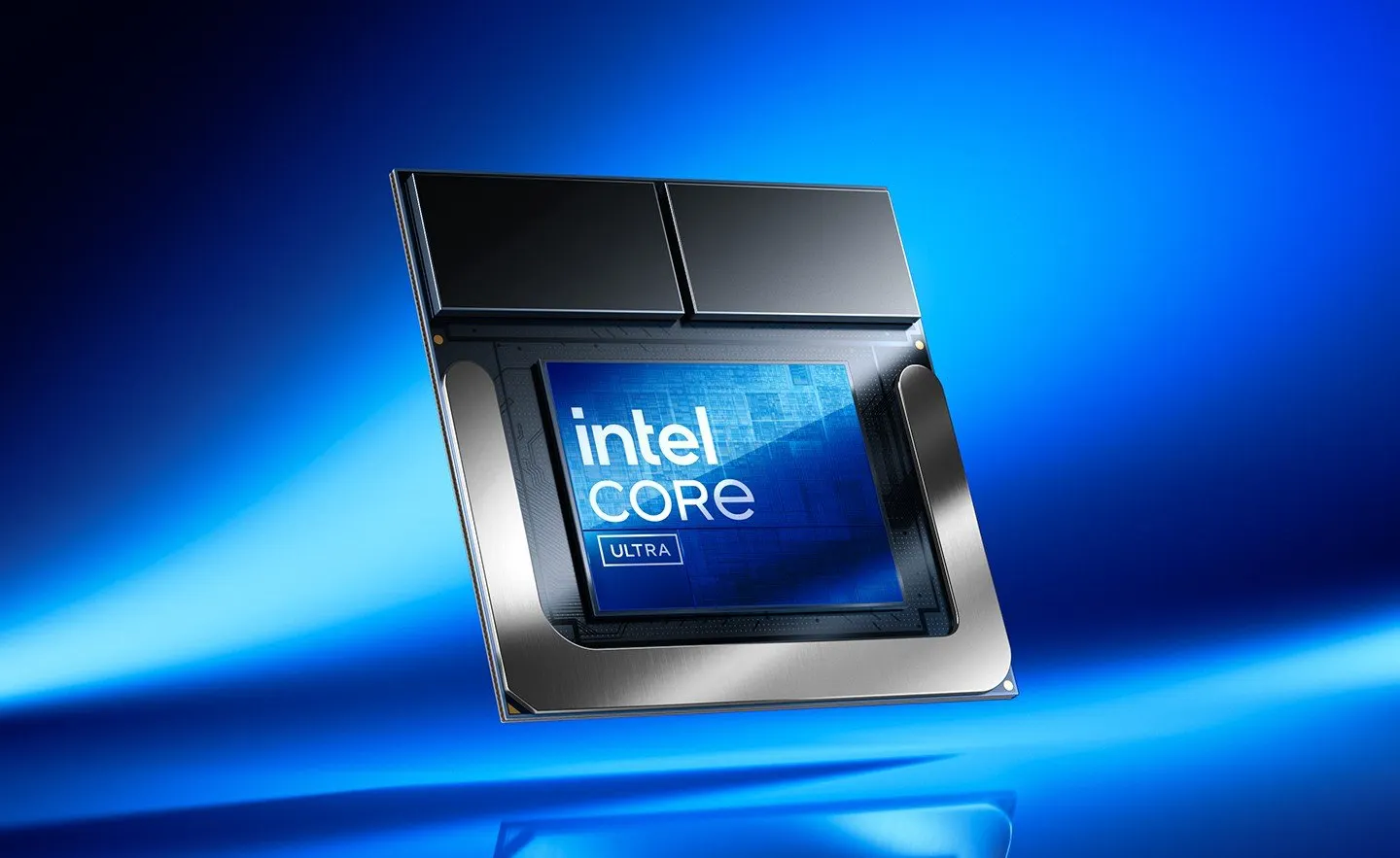
Intel’s upcoming Panther Lake CPUs, expected to launch in the second half of 2025 as the Core Ultra 300 series, are a major shift to the company’s mobile CPU strategy. Recent leaks have revealed key details about these chips, including their core configurations, manufacturing process split between Intel’s 18A node and TSMC’s N3E, and notably: enhanced GPU performance through the new Xe3 “Celestial” architecture.
Core architecture and configuration
According to recent leaks from Moore’s Law is Dead, the flagship Panther Lake-H processors will feature a heterogeneous design with up to 16 cores and 16 threads. The configuration consists of 4 Cougar Cove performance cores (P-cores), 8 Darkmont efficiency cores (E-cores), and 4 Darkmont low-power efficiency cores (LPE-cores). This marks a departure from Intel’s hyperthreading approach, following the path established by Lunar Lake.
The processors utilize a multi-tile architecture with three active tiles. The CPU/SoC die, fabricated on Intel’s advanced 18A process node, houses the P-cores and E-cores along with over 50 TOPS of NPU capability for AI workloads. The GPU die is manufactured on TSMC’s N3E process, while the Platform Controller Die (PCD) uses TSMC’s N6 node, containing wireless/LAN, PCIe, security engine, and USB controllers.
Multiple SKU configurations have been leaked, including variants with different core and GPU combinations to address various market segments. The TDP range spans from 15W for Panther Lake-U models to 45W for high-performance Panther Lake-H variants, with some reports suggesting peak power limits reaching 64W.
GPU Performance: The Celestial Xe3 Architecture
One of Panther Lake’s most significant upgrades lies in its integrated graphics performance. The new processors will feature Intel’s Xe3 “Celestial” architecture – the third generation of Intel’s Arc graphics tech. The top-tier configurations will include up to 12 Xe3 GPU cores, a 50% increase from the 8 Xe2 cores found in Lunar Lake.
If the Xe3 cores maintain a similar shader configuration to Xe2, the 12-core variant could feature approximately 1,536 shaders compared to Lunar Lake’s 1,024 shaders. This increase in computational resources (combined with architectural improvements) makes Panther Lake as a potentially compelling option for gaming handhelds and thin gaming laptops.
Performance estimates from various sources suggest the Xe3 GPU could deliver 15-30% better gaming performance compared to Lunar Lake at the same power envelope. Once drivers mature, Panther Lake might be able to surpass AMD’s Strix Point APU when pushed to 45W power levels. In addition, the GPU is also expected to contribute 120 TOPS of AI performance for the platform, making it suitable for AI-accelerated work.
Manufacturing Challenges Overcome?
Intel’s decision to split Panther Lake’s manufacturing across its own 18A node and TSMC’s processes reflects both ambition and pragmatism. The CPU cores on Intel 18A represent a critical test for Intel’s foundry capabilities and its path to manufacturing leadership. However, reports suggest the development hasn’t been without challenges.
According to sources cited by Moore’s Law is Dead, Intel has faced yield issues with the 18A process during development. One Intel engineer reportedly stated that “yields were horrible, we had to deal with constantly dying test boards, and everyone was pulling overtime shifts in an attempt to launch it early because leadership knew it can’t compete with Zen 6.”
However, Intel demonstrated working Panther Lake systems at CES 2025, with ODM laptops and mini dev kits running on early A0 silicon. This suggests the company has overcome initial production hurdles, though questions remain about yield rates and profitability.
Market Positioning and Competition
Panther Lake faces heavy competition from AMD’s Strix Point (Ryzen AI 300) CPUs – and that doesn’t take into account AMD’s next-generation offerings. The AMD Ryzen AI 9 HX 370, with its 12 cores (4 Zen 5 + 8 Zen 5c) and RDNA 3.5 graphics, is showing strong performance in both CPU and GPU workloads.
Benchmark comparisons show mixed results. Phoronix’s testing revealed that AMD’s Strix Point processors significantly outperform Intel’s current Lunar Lake in multi-threaded Linux workloads, with the Ryzen AI 9 365 showing 57% better average performance than the Core Ultra 7 256V. However, Intel’s single-threaded performance and power efficiency improvements with Lunar Lake have been notable.
For gaming performance, AMD claims its Ryzen AI 300 series offers 75% better gaming performance than Lunar Lake on average. Panther Lake’s enhanced GPU performance will need to close this gap significantly to remain competitive.