

Dell released the new Alienware lineup a bit earlier than expected, and so we learned that the M17x came with an option for a still rather mysterious AMD Radeon HD 7970M. Now that the specs for the 7000M series are official it looks like–at least according to AMD– that the 7970M is vastly superior to the HD 6990M and therefore also Nvidia’s mobile flagship, the GTX 675M (which is actually a renamed GTX 580M).
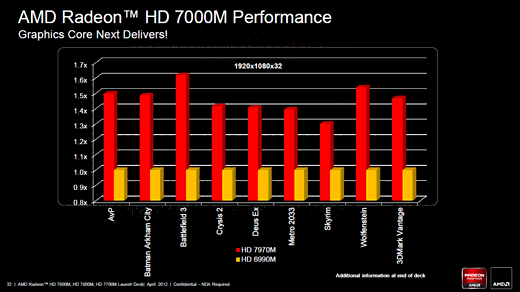
According to AMD’s slides the 7970M is a full 60% faster than the 6990M in Battlefield 3, 40% faster in Crysis 2, Metro 2033 and Deus Ex and 30% faster in Skyrim, among other good news. The ball is now in Nvidia’s court to deliver a similarly high-end mobile Kepler GPU, considering that the rebadged 675M gets a good beating by its new competitor. A prospective GTX 680M might turn the tables again.
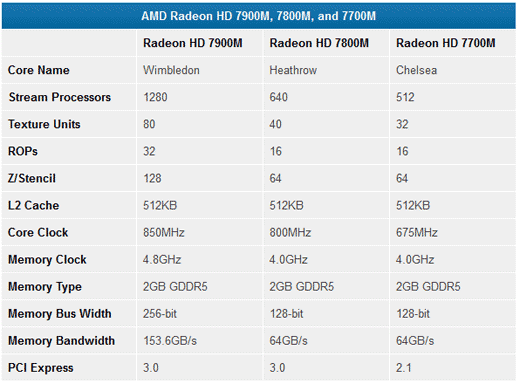
Compared to the 6990M, the 7970M boosts the number of stream processors from 1120 to 1280 and the core clock from 715 MHz to 850 MHz, while the video RAM is still 2 GB of GDDR5 (256-bit memory bus in both cases). Of course this is just part of the story, since the HD 7970M is built on the brand new 28nm Graphics Core Next (GCN) architecture.
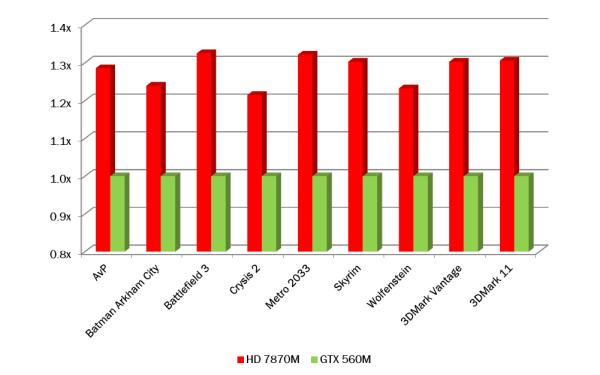
Similar estimates put the new HD 7870 well ahead of the GTX 560M in the mid field and the HD 7770M roughly on par with the same competitor, but with a considerably reduced power consumption to deliver that same amount of performance.
Another important detail that makes the new 7000M series much more competitive is AMD’s new ‘Enduro’ technology, which is a substitute for Nvidia’s Optimus that switches between the dedicated GPU and the Intel IGP on the driver level to save power. Optimus has been a strong selling point for the mobile Nvidia GPUs, as it vastly improves battery life without the need for manual switching.
At the same time, AMD’s so-called ZeroCore technology reduces the chip’s power consumption to virtually nothing when it is idle, and Power Gating saves power by shutting down parts of the chip when the GPU is not fully utilized and dynamically powers them back up when the workload increases.
The new offerings from AMD look promising indeed, and they should show up in new laptops (besides the M17x) soon enough. Let’s hope that the drivers are also up to speed, as this has been AMD’s weak spot in the past.
Slides are from AnandTech, which has additional details.





Right, the shipping time will be longer. I would personally go with the 7970M. The GTX 675M is a rebranded 580M while the 7970 is built on the newer and more power efficient 28nm technology, plus it should be quite a bit faster if AMD’s own numbers are to be trusted. The downside I guess is that you don’t get Optimus or 3D Vision. AMD also has graphics switching and 3D support, but it’s not as good as Nvidia’s solutions IMO.
Hi Berg,
Sorry I guess I just figured it out, it has nothing to do with the actual hardware but just the shipping time right? By the way, would you recommend the Radeon over the GTX? Thanks for all your help!!
So…I would want a card without extended lead time? I had recently bought an Origin PC comp, initially I bought it with the GTX 675M graphics card, but then I decided to upgrade it to the AMD radeon 7970 which they state has an “extended lead time”, I don’t know if that was a good choice or not…
Hi Juz28us! It’s just fancy wording for delays. TSMC, the factory that makes both AMD’s and Nvidia’s graphics cards is allegedly not doing a very efficient job with the new and smaller 28nm production process.
Hi Berg! I was wondering if you can explain to me what the significance of extended lead time is in regard to graphics cards? I looked everywhere and I really can’t find any information regarding it, thanks a lot for your help!